The Science Behind Virtual Reality: How It Tricks Our Brain
16 May 2026
Virtual reality (VR) feels like magic, doesn’t it? You put on a headset, and boom—you’re standing on a mountaintop, battling robots, or walking through the streets of ancient Rome. It’s jaw-dropping. But have you ever wondered how it actually works? More importantly, how does it fool your brain into thinking you're somewhere else entirely?
Well, grab your virtual backpack and let’s deep-dive into the fascinating science behind VR—how it works on a psychological and neurological level, and how it manages to toy with your senses so convincingly.
What Is Virtual Reality, Really?
Alright, let’s start with the basics.Virtual reality is a computer-generated simulation that allows you to interact with a 3D environment in a way that feels real. It usually involves some combo of a headset, hand controllers, and sometimes even full-body suits or treadmills for immersive experiences.
But the cool part isn’t just the tech—it's how our brains respond to that tech.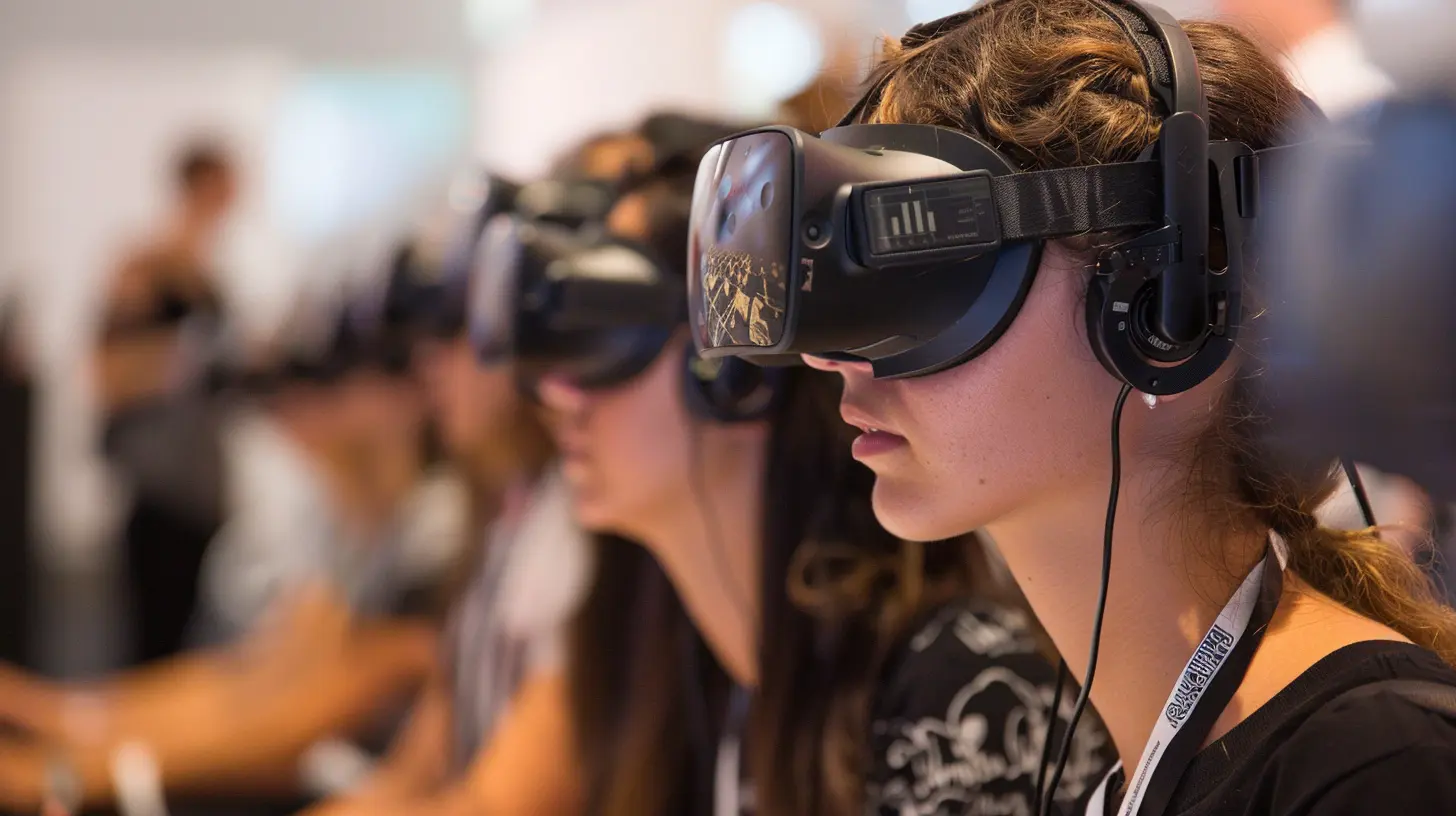
Hacking the Human Brain: The Core of VR
At its core, VR isn't just about visuals or sound effects. It's about targeting your brain’s perception system. Your brain is like a super-powered prediction machine. It's constantly processing input from your senses—what you see, hear, and feel—and stitching all that together to create a mental model of your reality.VR hijacks this system. It manipulates the senses just enough to short-circuit the brain into accepting a simulated world as real—even if it knows logically that it’s “just a game” or a simulation.
Let’s break down how it does that.
Your Eyes Believe What They See
1. Stereoscopic Vision: Fake Depth, Real Belief
Your eyes see the world slightly differently. Your brain merges the two viewpoints to give you depth perception. VR headsets mimic this by showing each eye a slightly different image. This is called stereoscopic imaging.The result? A whopping sense of depth—like you could reach out and grab an object, even though there's nothing physically there. Your brain buys it because it’s used to interpreting these visual cues from the real world.
2. Field of View and Head Tracking
A huge part of feeling "present" in VR is giving you a realistic field of view (FOV). The wider it is, the more natural it feels. Combine that with head tracking—where the virtual environment shifts as you move your head—and your brain begins to truly believe in this artificial world.Ever turned your head in a VR game and instinctively ducked to avoid a flying object? That’s your brain's trust kicking in.
Trick Your Ears, Trick Your Mind
Sound is where things get sneaky.3D Spatial Audio
VR doesn't just play sounds—it places them in a 3D space around you. Footsteps coming from behind? A bird chirping in the distance? The directional audio cues paint an audio landscape that enhances immersion dramatically.Try playing VR on mute. It just doesn’t hit the same, right? That’s because your ears help build your sense of presence, not just your eyes.
Touch and Haptics: The Illusion of Feeling
Okay, so what about touch? After all, you know that your hands aren’t actually touching that virtual sword or that zombie’s face (gross), but it feels kinda real.Haptics: When Vibration Becomes Communication
VR devices use haptic feedback—vibrations, resistance, even pressure—to simulate touch. And again, your brain is eager to believe it. Vibro-tactile cues can simulate textures, impacts, or even the sensation of holding an object.Crazy, right? It’s like your brain fills in the blanks. A little buzz when you pick up a virtual object? Suddenly it feels heavy, substantial—even though it’s all in your head (literally).
The Role of Motion and Balance
One of the trickiest challenges in VR is making movement feel natural without making you queasy.Vestibular Mismatch: Why VR Can Make You Nauseous
Here’s the problem: Your visual system says you're moving, but your inner ear (vestibular system) says you’re standing still. This sensory conflict is what causes “VR sickness.”Your brain expects congruent input—when that doesn't happen, it gets confused. And for some folks, that confusion = nausea.
Developers are constantly coming up with clever solutions: teleportation movement, snap turning, and comfort settings, all designed to minimize the disconnect and keep your stomach settled.
Time: The Final Frontier of Immersion
This one's subtle, but powerful.Altered Sense of Time in VR
Ever put on a VR headset for a “quick 10 minutes” and look up to find an hour has gone by? In VR, your sense of time can warp because you're deeply immersed and your usual environmental cues are missing.That temporal disorientation? Another sign that your brain is fully on board with the virtual-verse.
Mirror Neurons and Presence: Becoming Your Avatar
Let’s get a little neuroscience-y, shall we?Mirror Neurons: Why You Feel What Your Avatar Feels
Your brain has something called mirror neurons—cells that fire both when you do something and when you watch someone do it. In VR, your brain treats your avatar (your virtual self) as an extension of you.Get hit in the virtual arm? Even though you know it’s not real, you may flinch or react physically. That’s your mirror neurons empathizing with your digital self. Wild, right?
How the Brain Rewires in VR
Studies have shown that repeated VR use can actually change the way the brain processes experiences.Neuroplasticity in Action
VR has been used in therapy, rehab, education, and even military training, because the brain can form new neural pathways from virtual experiences—just like it does from real ones.The implications? Massive. You can train skills, reduce phobias, or even treat PTSD using VR. Your brain doesn’t distinguish much between a virtual and real experience if the sensory data is convincing enough.
The Power of Believability Over Realism
Here’s the kicker: VR doesn’t need to be ultra-realistic to be immersive. Your brain doesn’t demand perfection—it just needs enough cues to believe the world is real.A blocky, cartoonish VR environment can feel just as immersive as a photo-realistic one, as long as it provides the right sensory and spatial feedback. It's the coherence of sensory information that matters more than hyper-real graphics.
Think of it like watching a play—you know the stage is fake, but if the acting and story are compelling, you’re all in.
Why Presence Is the Holy Grail of VR
Presence is that magical feeling of "being there." It’s not just about visuals or fancy tech—it’s about convincing your brain that the virtual world is real enough to engage with.The stronger the presence, the more emotionally and cognitively engaged you become. That’s what makes VR powerful—not just for games, but for things like education, empathy training, and even therapy.
So, What’s Next?
As VR tech continues to evolve—think retinal displays, smell simulators, full-body haptics—we’re getting closer to fully immersive, believable worlds that could be almost indistinguishable from reality.But even today, with just a headset and a pair of controllers, we’re already experiencing worlds that can trick our brains in extraordinary ways.
So the next time you’re slicing virtual fruit or exploring alien galaxies, remember: your reality is being hacked—and your brain is totally cool with it.
Final Thoughts
Virtual reality isn’t just some nerdy gimmick—it’s one of the coolest intersections of psychology, neuroscience, and technology. By tapping into how we perceive the world, VR doesn’t just show us an alternate reality. It makes us feel like we’re inside it.And honestly, that’s kind of magical.
all images in this post were generated using AI tools
Category:
Virtual RealityAuthor:

Jerry Graham
Discussion
rate this article
2 comments
Zinna McFarlane
Virtual reality's brain tricks reveal fascinating insights into perception and immersive experiences.
July 12, 2026 at 4:32 AM
Jerry Graham
I'm glad you found it fascinating! Virtual reality really does open up new ways to understand how our brain processes experiences.
Emmeline Pruitt
Fascinating insights on perception!
May 19, 2026 at 12:38 PM
Jerry Graham
Thanks! I'm glad you found it interesting.