A Deep Dive into the Tech Behind AR Glasses
18 January 2026
Picture this: you're walking down the street, and little digital breadcrumbs light up your path. You blink, and restaurant reviews float beside a cozy café's sign. A call from your best friend pops up in the corner of your vision—no phone in sight. Sounds like science fiction, right? Nope. This is the magic and madness behind Augmented Reality (AR) glasses—and today, we're taking the plunge to understand what really makes them tick.
So buckle up. We're diving deep beneath the shiny surface into the circuits, sensors, and sorcery that power AR glasses. Ready?
🌐 What Even Are AR Glasses?
Let’s not get ahead of ourselves. Before we geek out on tech specs and futuristic optics, let’s make sure we’re all on the same page.AR glasses are wearable technology that superimpose digital content onto the real world. Think Google Maps arrows on sidewalks, translation bubbles floating in the air, or even virtual pets chilling on your couch. It's not full-on virtual reality (where you're dropped into an entirely artificial world), but a blend—the real + the unreal. Augmented.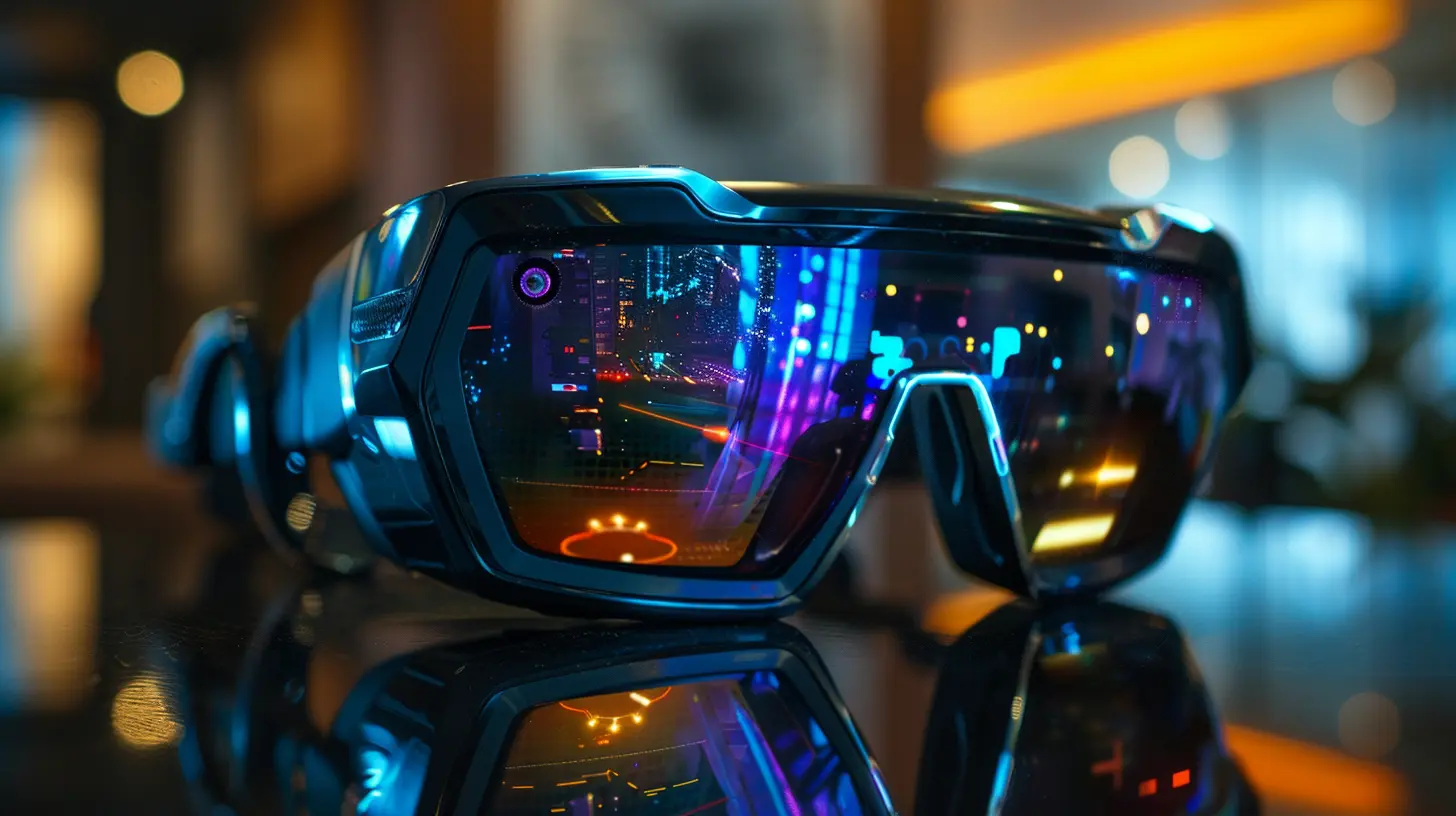
🧠 The Brains: Processing Power in a Tiny Frame
Alright, let’s talk brains. AR glasses aren’t just sophisticated lenses. They’re miniaturized computers. We’re talking CPUs, GPUs, and even AI processors—all squeezed into frames sleek enough that you don’t look like a cyborg.🔧 System-on-a-Chip (SoC)
SoC is like a Swiss army knife in chip form. It's a single component that houses everything needed to process and render AR visuals in real time. Qualcomm’s Snapdragon XR series is a popular kid in the class, built specifically with XR (Extended Reality) in mind.🔋 Battery Life: The Eternal Nemesis
With all that brainpower jam-packed into a tiny frame, keeping AR glasses juiced up is a high-stakes balancing act. Most models use custom compact batteries or conductive stems charging through accessories like cases or magnetic cords. Some are even experimenting with solar cells and kinetic energy harvesting. Spicy, right?
👓 The Eyes: Display Technologies That Bring the Magic
Now the juicy part—how the visuals appear.Imagine trying to project a 3D hologram onto your real-world view. Not easy. That’s where insanely clever display technologies come into play.
🖼️ Waveguides: Light Bending Wizards
Waveguides are the main magic trick. They guide and manipulate light through the lenses to show the digital imagery directly into your eyeballs without blocking your natural sight. Think of them as tiny highways that steer images from the display to your retina with laser-like precision.There are two primary flavors here:
- Diffractive Waveguides – Use diffraction gratings to control light (Think: complex glass etchings)
- Reflective Waveguides – Use physical mirrors or reflectors built inside the lens
Each has its pros and trade-offs in clarity, color accuracy, and cost.
💡 Microdisplays: Projectors for Your Eyes
Here’s where the projected images originate. These microdisplays are teeny-tiny (like a grain of rice) but capable of rendering vibrant, high-definition content. The main contenders?- OLED (Organic Light Emitting Diode) – Great contrast and colors
- LCOS (Liquid Crystal on Silicon) – Sharper text, lower brightness
- MicroLED – The new kid. Crazy bright, super efficient, expensive
Pair this with the waveguides and boom—you get a holographic heads-up display without the need to carry a lightsaber.
🕶️ The Smarts: Sensors and Spatial Awareness
What's the point of visuals if they don’t line up with the real world? You’d be trying to poke a virtual button and end up swatting the air like a maniac. That’s where sensors come in.🧭 IMUs: Your Inner Sense of Direction
IMU stands for Inertial Measurement Unit—a trio of gyroscopes, accelerometers, and magnetometers that track head orientation and movement. This helps your AR glasses "know" where you're looking and how you're moving. Think of it as your internal GPS.📷 Cameras & Computer Vision
Most high-end AR glasses come with multiple cameras. Not for selfies (though that’s a side bonus), but for mapping the environment.These cameras let the glasses understand:
- Surfaces and depth
- Object location and movement
- Hand gestures
- Faces and eye movement
They feed into computer vision algorithms that give your glasses a sixth sense. It’s like giving your eyewear Spidey senses.
🌍 SLAM: Mapping the World on the Fly
Simultaneous Localization and Mapping. SLAM lets the glasses build a map of your surroundings while tracking your movement within it. It’s what lets digital dragons land on your coffee table and stay there when you move your head.🔊 The Sound of Immersion: Spatial Audio & Bone Conduction
Okay, you've got visuals floating in mid-air, but what about sound? Imagine getting a virtual tour of a museum, and someone whispers facts into your ear—but no one else hears it. That’s spatial audio.🧠 Bone Conduction
Instead of plugging your ears with speakers, AR glasses often use bone conduction. Tiny vibrations travel through your cheekbones directly to your inner ear. Say hello to whispering tech that keeps your ears open to the world.🕥 3D Spatial Audio
This isn't just “left or right” stereo sound. Spatial audio adds directionality and distance. A sound coming from your right-front feels exactly like someone standing there.It might not seem essential… until it enhances everything from gaming to navigating crowded streets.
🧑🚀 User Interface: How You Interact with the Invisible
Now that you can see and hear the augmented world, how do you interact with it? Spoiler: it’s not through clicks and swipes.✋ Hand and Finger Tracking
AR glasses like the HoloLens 2 allow you to pinch, swipe, and tap in mid-air. Cameras track the position of your fingers and hands with surgical precision. It’s Minority Report in real life.👁️ Eye Tracking
Where you look is often where you want to act. Eye-tracking tech follows your gaze to help initiate actions—like selecting a menu item just by staring at it.🎙️ Voice Commands
Thanks to NLP (Natural Language Processing) and onboard AI, you can talk to your glasses just like you would to Alexa or Siri.📡 Connectivity: Keeping the Cloud Close
AR glasses are hungry—data-hungry. And they need to stay connected.🌐 Wi-Fi and Bluetooth
The basics. Most glasses seamlessly tether to your phone for apps, notifications, and streaming.📶 5G and Edge Computing
This is where the big guns come in. For heavy lifting, AR glasses offload rendering or AI tasks to the cloud using fast mobile data (like 5G) and edge computing hubs nearby.The payoff? Lighter glasses with longer battery life and real-time performance.
🔒 Privacy and Security: Seeing Everything, Respecting Boundaries
Let’s pause and get serious.When you wear a device capable of recording audio, video, and your surroundings 24/7, privacy is no longer a footnote—it’s front and center.
Manufacturers are starting to:
- Add LED indicators during recording
- Encrypt local data
- Offer opt-in permissions for shared AR spaces
But this space needs guardrails. The ethical development of AR will decide if we end up in a utopia—or an Orwellian surveillance soup.
🧬 The Role of AI: The Silent Partner
Behind all the head-tracking, object recognition, and responsive AR overlays is Artificial Intelligence.🤖 AI for Environmental Understanding
AI helps AR glasses:- Recognize your living room versus a city street
- Customize content based on what’s around you
- Predict what you might want to see next
It’s the digital glue that keeps experiences coherent.
🧠 On-Device vs. Cloud AI
Some AI models run locally on-device (fast but limited), while others rely on cloud power (stronger but needs data). Future AR glasses aim to smartly switch between the two for seamless performance.📈 The Future of AR Glasses: Where Are We Headed?
Let’s be honest. AR glasses today are still in the early innings of a long game. But momentum is building.🔮 What’s Coming Soon?
- Lighter, sleeker designs — that look just like regular glasses- Improved battery life — thanks to next-gen materials and chipsets
- Full-day use cases — from work productivity to social media
- Mass adoption — with Apple, Meta, and Samsung all in the race
We might soon reach a point where AR glasses become as essential as smartphones. Crazy? Maybe. But so was the idea of a computer in your pocket, once upon a time.
🧩 Final Thoughts: Seeing the Future Through a New Lens
AR glasses are not just gadgets—they’re gateways. Merging the digital and physical into a seamless experience that augments how we work, play, and connect.Sure, the tech is complex. But when it comes together just right? It’s nothing short of magic. A dance of light, sound, and code—wrapped around your face. The future isn't just near; it's staring right into our eyes.
all images in this post were generated using AI tools
Category:
Ar GlassesAuthor:

Jerry Graham
Discussion
rate this article
2 comments
Lennox McMahan
This article brilliantly unpacks the fascinating technology propelling AR glasses forward. I’m particularly intrigued by the potential applications in everyday life and industries like healthcare and education. It’s exciting to imagine how seamlessly integrated AR could become in our daily routines. What's next on the horizon for this technology?
February 4, 2026 at 6:06 AM
Jerry Graham
Thank you for your insightful comment! The next frontier for AR glasses includes advancements in AI integration, improved battery life, and enhanced user interfaces, which will further expand their applications in everyday life and various industries. Stay tuned!
Ariana McFarland
Great insights into AR glasses technology! The exploration of hardware and software integration really highlights the future potential.
January 19, 2026 at 12:45 PM
Jerry Graham
Thank you! I'm glad you found the insights valuable. The integration of hardware and software is indeed a game-changer for the future of AR glasses!