How to Use Your Smartphone Without Destroying Your Eyes
8 August 2026
Your smartphone is not a medical device. It is a tool, a toy, a workhorse, and a source of endless distraction. But it is also a source of constant, low-level strain on your eyes, and most people are doing absolutely nothing about it. The good news is you do not need to throw your phone into a lake. You need to understand how light, distance, and behavior interact with your visual system, and then make a few deliberate changes.
The problem is not the screen itself. The problem is how you use it. The distance you hold it, the lighting around you, the length of time you stare without blinking, and the angle of your head all matter more than the latest blue light filter app. If you want to protect your eyes without giving up your device, you need to think like an optometrist, not like a consumer.
The Real Threat Is Not Blue Light
Let us deal with the most overhyped issue first. Blue light is not your enemy. It is a portion of the visible spectrum with short wavelengths and high energy. Your eyes are exposed to blue light all day, every day, from the sun. The sun emits far more blue light than any smartphone ever will. If blue light were inherently destructive, humans would have gone blind centuries ago.What matters is timing and intensity. Blue light in the morning and afternoon helps regulate your circadian rhythm. It keeps you alert and tells your body it is daytime. Blue light at night, especially in the hours before sleep, can suppress melatonin production and make it harder to fall asleep. That is a real effect, but it is not the same as causing permanent retinal damage.
The fear of blue light causing macular degeneration is largely theoretical. Some laboratory studies show that high-intensity blue light can damage retinal cells in animals, but the exposure levels are nowhere near what you get from a phone screen. The American Academy of Ophthalmology does not recommend special blue light glasses for the general public. They say the evidence is not there.
So what is the actual threat? It is eye strain, dry eyes, and a disrupted sleep cycle. Those are not trivial. They affect your comfort, your productivity, and your long-term visual habits. And the fix is not a $200 pair of glasses. It is better behavior.
The 20-20-20 Rule Is Not Enough
You have heard of the 20-20-20 rule. Every 20 minutes, look at something 20 feet away for 20 seconds. It is a nice reminder, but it is a band-aid. The rule exists because when you focus on something close, your ciliary muscles contract and hold that contraction. Over time, that sustained contraction causes fatigue, headaches, and blurred vision. Looking into the distance relaxes those muscles. That is the theory, and it works.But 20 seconds every 20 minutes does not undo hours of poor posture, bad lighting, and excessive screen time. It is a maintenance habit, not a cure. You need to think in terms of sessions, not intervals.
A better approach is to structure your phone use into blocks. If you are going to read an article, reply to messages, or watch a video, decide how long you will do it. After 30 to 40 minutes of continuous close-up work, take a real break. Get up, walk around, look out a window, or just close your eyes for a minute. The goal is to change the focal distance and let your eye muscles reset. Twenty seconds helps. Two minutes is better.
The deeper issue is that most people do not notice the strain until it becomes a headache or a burning sensation. By then, the damage to your comfort is done. Prevention requires awareness, and awareness requires you to check in with your body. Ask yourself: Are my eyes feeling tight? Am I blinking? Is my neck forward? If you cannot answer those questions, you are too deep in the screen.
Hold Your Phone Farther Away
This is the single most effective change you can make. Most people hold their phone between 8 and 12 inches from their face. That is too close. At that distance, your eyes have to work harder to maintain focus, and your convergence system has to pull your eyes inward to keep the image single. Both of those systems are working overtime.The ideal distance is 16 to 18 inches. That is roughly the distance from your elbow to your wrist. If you hold your phone at arm's length, you are in the right zone. It feels awkward at first because you have trained yourself to hold it close. But after a few days, it becomes natural.
Why does this matter? Your eyes are designed for distance vision. Close-up work is a modern invention. The ciliary muscle that changes the shape of your lens has to stay contracted when you look at something near. The closer the object, the harder the contraction. Over years, this constant near-work is associated with the development and progression of myopia, or nearsightedness. The exact mechanism is still being studied, but the correlation is strong. Kids who spend more time outdoors and less time on screens have lower rates of myopia. The distance of your screen is part of that equation.
There is a trade-off. Holding your phone farther away makes text smaller. That is why people pull it close in the first place. The solution is to increase the font size. Most smartphones let you scale text up significantly. Do that. A larger font at a farther distance is far better for your eyes than a tiny font at close range. Your eyes will thank you, and your neck will too.
Lighting Is Everything
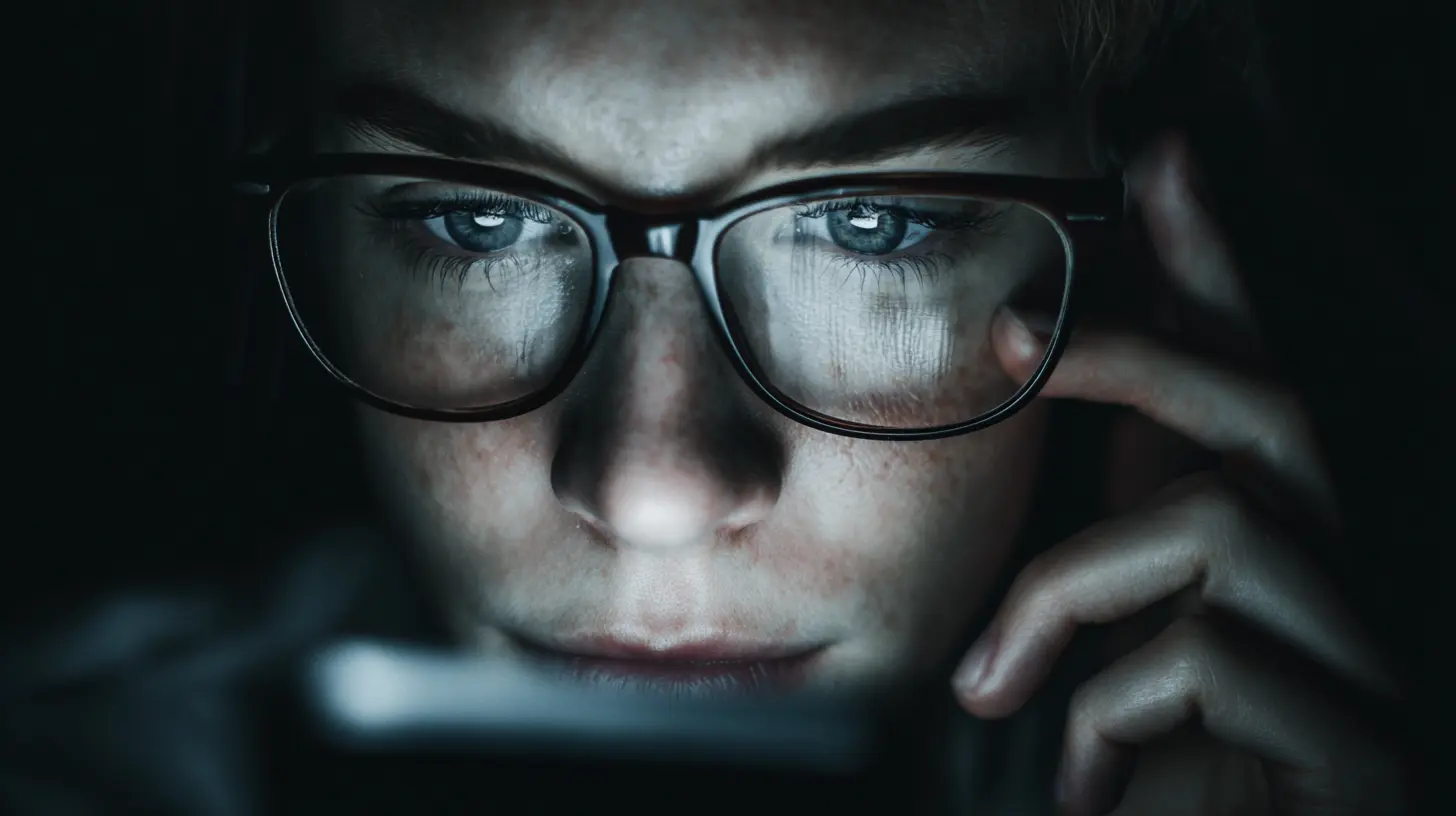
The ambient lighting in the room matters as much as the brightness of your screen. If you use your phone in a dark room, the contrast between the bright screen and the dark surroundings forces your pupils to dilate and constrict rapidly. This causes strain and makes your eyes work harder to adapt. It also makes the screen appear brighter than it actually is, which can trigger squinting and dryness.The rule is simple: the lighting in the room should be similar to the brightness of your screen. Not identical, but not drastically different. If you are in a bright room, your screen can be bright. If you are in a dim room, lower the screen brightness. If you are in a dark room, do not use your phone at all. That is the worst possible scenario.
Many people use their phones in bed with the lights off. This is one of the most damaging habits for your eyes and your sleep. The high contrast causes strain, and the blue light suppresses melatonin. If you must use your phone in bed, use a dim night light or a lamp on the lowest setting. Better yet, put the phone down and read a physical book. Your eyes will reset, and you will sleep better.
Do not rely on auto-brightness alone. Auto-brightness is a rough approximation. It adjusts to the overall light level, but it does not account for the content on your screen. A white webpage in a dark room will still be too bright, even if the sensor dims the display. Set your brightness manually, and adjust it as the room lighting changes. It takes two seconds and saves your eyes hours of strain.
Blink More, and Use Eye Drops If You Need To
This sounds ridiculous, but it is true: people blink less when they use screens. The normal blink rate is about 15 to 20 blinks per minute. When you are staring at a screen, that drops to 5 to 7 blinks per minute. Blinking spreads tears across the surface of your eye, keeping it lubricated and clear. When you blink less, your tears evaporate, and your eyes become dry, gritty, and irritated.You cannot force yourself to blink more just by thinking about it. The reason you stop blinking is that your visual attention narrows when you focus on a screen. The best way to increase blinking is to take breaks. Every time you look away from the screen, you blink naturally. Every time you stand up, you blink more. The 20-20-20 rule helps here, but again, it is not enough.
If your eyes feel dry after a long session, use artificial tears. Look for preservative-free single-dose vials. They are more expensive, but they do not contain chemicals that can irritate your eyes with frequent use. Do not use redness-reducing drops. Those shrink blood vessels and can cause rebound redness after the effect wears off. They do not address the underlying dryness.
Another trick is to consciously do a full blink. A full blink is when your upper and lower eyelids meet completely. Many people do partial blinks, where the lid only comes down halfway. Partial blinks do not spread tears evenly. Practice full, slow blinks when you notice your eyes feeling tired. It sounds silly, but it works.
The Angle of Your Head Matters More Than You Think
Most people look down at their phones, which means they tilt their heads forward and down. This puts enormous strain on your cervical spine and your neck muscles. The average human head weighs about 10 to 12 pounds. For every inch you tilt it forward, the effective weight on your neck increases. At a 45-degree angle, your neck is supporting the equivalent of nearly 50 pounds. That is not sustainable.This is called tech neck, and it has a direct effect on your eyes. When your neck is strained, your shoulder and upper back muscles tense up. This tension can refer pain to your head and around your eyes. It can also cause tension headaches, which you might mistake for eye strain.
The fix is to bring the phone to your eye level instead of dropping your head to the phone. Sit up straight, pull your shoulders back, and hold the phone at eye height. This feels unnatural because it requires your arms to be up. You can prop your elbows on a desk or use a phone stand. If you are lying in bed, hold the phone above your face, not to the side. It is not comfortable at first, but it protects your neck and reduces the secondary strain on your eyes.
If you use your phone for long reading sessions, consider a tablet or a laptop instead. A larger screen at a proper distance is always better than a small screen held close. The bigger the screen, the less your eyes have to strain to resolve small details. That is not a luxury; it is a practical choice.
Night Mode Is Useful, But Not For What You Think
Night mode, or dark mode, changes the color temperature of your screen to reduce blue light emission. It is built into most phones and can be scheduled to turn on at sunset. This is genuinely useful, but not because it protects your eyes from damage. It helps because it reduces the amount of bright, cool light that tells your brain it is still daytime. That can help you wind down before bed.The problem is that people use night mode as a license to use their phones in the dark for hours. That is wrong. Night mode does not reduce eye strain. It does not make it safe to stare at a screen in a pitch-black room. It only changes the color palette. The contrast between the screen and the dark room is still high. The distance is still too close. The blink rate is still too low.
Use night mode as a signal. When your screen turns amber, that means it is time to start wrapping up your screen use. Not to keep scrolling. Set a hard cutoff time, maybe 30 to 60 minutes before bed. Your eyes and your brain need that time to transition into sleep mode. If you cannot fall asleep without looking at your phone, you have a dependency, and the phone is not helping you.
Glasses and Screen Protection Are Not the Answer
There is a whole industry selling blue light blocking glasses, screen protectors with blue light filters, and anti-glare films. Most of these are marketing solutions to a behavioral problem. The evidence that blue light blocking glasses reduce eye strain is weak. A 2017 study published in Ophthalmic and Physiological Optics found no significant difference in eye strain between people wearing blue light blockers and those wearing placebo glasses. The people who believed they were wearing blue light blockers reported less strain, which tells you something about the placebo effect.Anti-glare screen protectors can help in specific situations. If you are using your phone near a window or under direct overhead lighting, glare can cause you to squint. A matte screen protector reduces reflections. But it also reduces sharpness and can make text look slightly fuzzy. That fuzziness can cause more strain than the glare it eliminates. Test one before you commit. If you do not notice a difference, skip it.
The only glasses that are proven to help are prescription glasses for people who need them. If you have astigmatism, presbyopia, or any uncorrected refractive error, wearing the right prescription makes a huge difference. Many people struggle with screens because they are due for an eye exam. If you have not had one in the past two years, get one. That is the single most evidence-based step you can take.
Common Mistakes People Make
The biggest mistake is using your phone as your primary reading device. If you read long articles, books, or documents, use an e-reader or a tablet. E-readers with e-ink displays do not emit light the way LCD or OLED screens do. They use reflected light, like paper. That is dramatically easier on your eyes. The trade-off is that e-ink screens have slower refresh rates and cannot display rich media. But for pure reading, they are superior.Another mistake is ignoring the font size. Most people leave their phone on the default font size, which is often too small for comfortable reading at the recommended distance. Go into your display settings and increase the font size. Make it larger than you think you need. If you feel like you are being handed a large-print book, that is the right size. It looks slightly ridiculous, but it is far better for your eyes.
People also forget to clean their screens. A smudged screen reduces contrast and forces your eyes to work harder to resolve text. Clean your screen regularly with a microfiber cloth. Do not use alcohol-based cleaners, as they can strip the oleophobic coating that repels oil. A dry microfiber cloth is usually enough.
When to See a Professional
If you experience persistent headaches, blurred vision that does not clear with blinking, double vision, or eye pain, do not self-treat. These can be signs of a refractive error, binocular vision dysfunction, or a more serious condition. Seeing an optometrist or ophthalmologist is not a sign of weakness. It is a smart move. They can measure your visual acuity, check your eye health, and give you specific advice based on your anatomy.Many people assume their eyes are fine because they can read the text on their phone. But reading a phone screen at close range is a forgiving task. It does not challenge your distance vision or your ability to change focus quickly. A comprehensive eye exam will catch issues that you would never notice on your own.
The Bottom Line
Your smartphone is not going to destroy your eyes if you use it sensibly. The problem is that most people use it in a way that maximizes strain. They hold it too close, in poor lighting, for too long, with too few breaks. They blame blue light and buy useless glasses instead of changing their behavior.The fix is not glamorous. It is a set of habits: hold the phone at arm's length, increase the font size, match the screen brightness to the room, take real breaks, blink more, and stop using the phone in the dark. None of these require spending money. They require discipline and awareness.
Your eyes are not fragile. They are remarkably resilient. But they are not designed for hours of close-up, high-contrast, static viewing. Respect that, and your phone will stay a useful tool instead of becoming a source of chronic discomfort. The choice is yours. The phone is not going to change. You have to.
all images in this post were generated using AI tools
Category:
Smartphone TipsAuthor:

Jerry Graham
Discussion
rate this article
1 comments
Shiloh McGehee
Smartphones are like candy for the eyes-sweet, but too much can hurt. This article is a timely reminder to balance screen time with eye care. Remember to take breaks, adjust brightness, and maybe even go old school with a book. Your eyes will thank you for the TLC.
August 27, 2026 at 3:56 AM
Jerry Graham
Thanks for the thoughtful comment! Balancing screen time is essential, and I appreciate your tips on taking breaks and adjusting brightness. A good book is always a great alternative!