The All-Remote Tool Stack for Startups in 2027
8 September 2026
So, you have decided to build a startup in 2027. Congratulations. You have also decided that your team will never, ever share a physical office. Even better. That means you need a tool stack that will let you collaborate with people who live in three different time zones, speak four different languages, and have never actually met each other in person. You need the perfect all-remote stack. And by "perfect," I mean you will spend the next twelve months switching between seventeen different subscriptions and still feel like you are herding cats through a spreadsheet.
Let me save you some time. I have been watching this circus for years, and the landscape in 2027 has finally settled into something almost coherent. The tools are not actually better than they were in 2024. They are just more expensive and have more AI features that nobody asked for. But you have to pick something, so let us walk through the stack that will keep your startup alive, your employees from quitting, and your investors from asking awkward questions about your burn rate.

The Communication Layer: Where Conversations Go to Die
First, you need a place for people to talk. In 2027, the default answer is still a chat application, but the market has split into two distinct camps. On one side, you have the real-time chat tools. On the other, you have the asynchronous-first platforms that promise to free your team from the tyranny of constant notifications.The Real-Time Chat That Pretends It Is Not Real-Time
Slack is still around, obviously. It has absorbed more features than a Swiss Army knife that someone left in a washing machine. It now has built-in video, project management views that nobody uses, and an AI that will summarize a thread you missed, badly, with the confidence of a junior consultant. In 2027, Slack is less a communication tool and more a museum of communication failures. Every channel is a graveyard of unanswered questions, and every DM is a passive-aggressive novel about who forgot to update the status.The alternative is Microsoft Teams, which is like Slack but with more corporate governance and a default setting that makes every meeting feel like a deposition. If your startup is doing anything regulated, you will end up here anyway. But if you are a small team trying to move fast, Teams will feel like wearing a suit to a beach party. It works, but you will be uncomfortable the whole time.
Here is the trade-off you need to consider. Slack is better for small teams that thrive on rapid, chaotic communication. It is worse for large teams because the noise level becomes unbearable. Teams is better if you live inside the Microsoft ecosystem and need deep integration with Office documents. It is worse if you value your sanity.
The Asynchronous Uprising
The real story of 2027 is that asynchronous communication finally got its act together. Tools like Twist and Threads (not the Meta one) have matured. They organize conversations by topic instead of by time. This sounds great in theory. In practice, it means that a simple question about the login page can take four hours to get an answer because everyone is waiting for the "right" time to respond in the "right" thread.I have seen startups adopt these tools and then realize that their employees still send DMs to each other anyway. The async platform becomes a place where you post updates for the record, and the actual work happens in private messages that no one else can see. This is the dirty secret of the all-remote stack. No matter what tool you pick, people will find a way to recreate the office gossip mill in private channels.
My recommendation for a startup in 2027 is to start with Slack or its open-source cousin, Rocket.Chat, and keep it lean. Create only a handful of channels. Force every decision to be documented in a linked wiki page. Do not let the chat tool become the source of truth. It will fail you.
The Project Management Nightmare
Next up is project management. This is where startups go to die, not because the tools are bad, but because the tools give you the illusion of progress. You will spend hours grooming a backlog, moving sticky notes across a digital board, and assigning story points that mean absolutely nothing to anyone outside your team.The Kanban Cult
Trello is still around, and it still works for simple lists. But in 2027, Trello feels like using a typewriter in a recording studio. It does one thing well, and that is it. If your startup is a content operation or a simple product with a clear linear workflow, Trello is fine. But the moment you have dependencies, cross-functional teams, or any kind of complex release cycle, Trello collapses.Asana and Monday.com have merged into a weird hybrid that tries to do everything. They have timelines, calendars, portfolios, goals, and a million templates. They also have a learning curve that rivals a PhD in information science. You will spend more time updating the tool than doing the work. That is not a joke. I have seen teams of eight people spend two hours a day on Asana, just to keep the statuses green.
The Document-Centric Approach
The smartest startups in 2027 have realized that most project management tools are overkill. They use a wiki with a simple task list. Something like Notion or Coda. These tools let you write a document that contains the plan, the tasks, and the context all in one place. You do not need to jump between a task tracker and a spec document. The problem is that Notion becomes a black hole of information. You will create pages for everything, nest them ten levels deep, and then lose them forever.The trick is to have a single "source of truth" page that links to everything else. If it is not linked from that page, it does not exist. This is a human discipline problem, not a software problem. No tool will save you from a team that does not maintain its own documentation.
For most startups in 2027, I recommend a hybrid approach. Use Linear for engineering tasks because it is fast and built for developers. Use Notion for everything else. Do not try to use one tool for all purposes. That is a recipe for disaster.
The Video Call Fatigue and Its Antidote
Video calls are the oxygen of the remote startup. They are also the reason everyone feels exhausted by 2 PM. In 2027, we have finally admitted that the future of work is not endless Zoom calls. It is a mix of short, focused video sessions and long periods of deep work.The Meeting Tool You Will Hate the Least
Zoom is still the default for external calls. It works. It is boring. But for internal meetings, more startups are using tools like Loom for asynchronous video. You record your screen, talk through your idea, and send the link. The recipient watches it at their own pace and sends a video back. This sounds efficient. It is efficient. But there is a dark side. People start recording videos for things that should just be a text message. You will get a ten-minute video explaining a one-paragraph change. That is worse than a meeting.The best practice for 2027 is to have a strict meeting policy. No meeting without an agenda. No meeting longer than 30 minutes. No meeting if a video or a document would suffice. The tool does not matter if your culture is addicted to synchronous interaction. If you find yourself booking back-to-back calls all day, you are not remote. You are just in an office that is inside your house.
The Hardware Problem
People forget that the tool stack includes hardware. In 2027, a good headset with a decent microphone is more important than any software subscription. Your team will judge you by the audio quality of your stand-up. If you sound like you are broadcasting from a fish tank, no software will fix that. Spend money on good microphones, cameras, and lighting. It is the highest ROI investment you can make for a remote team.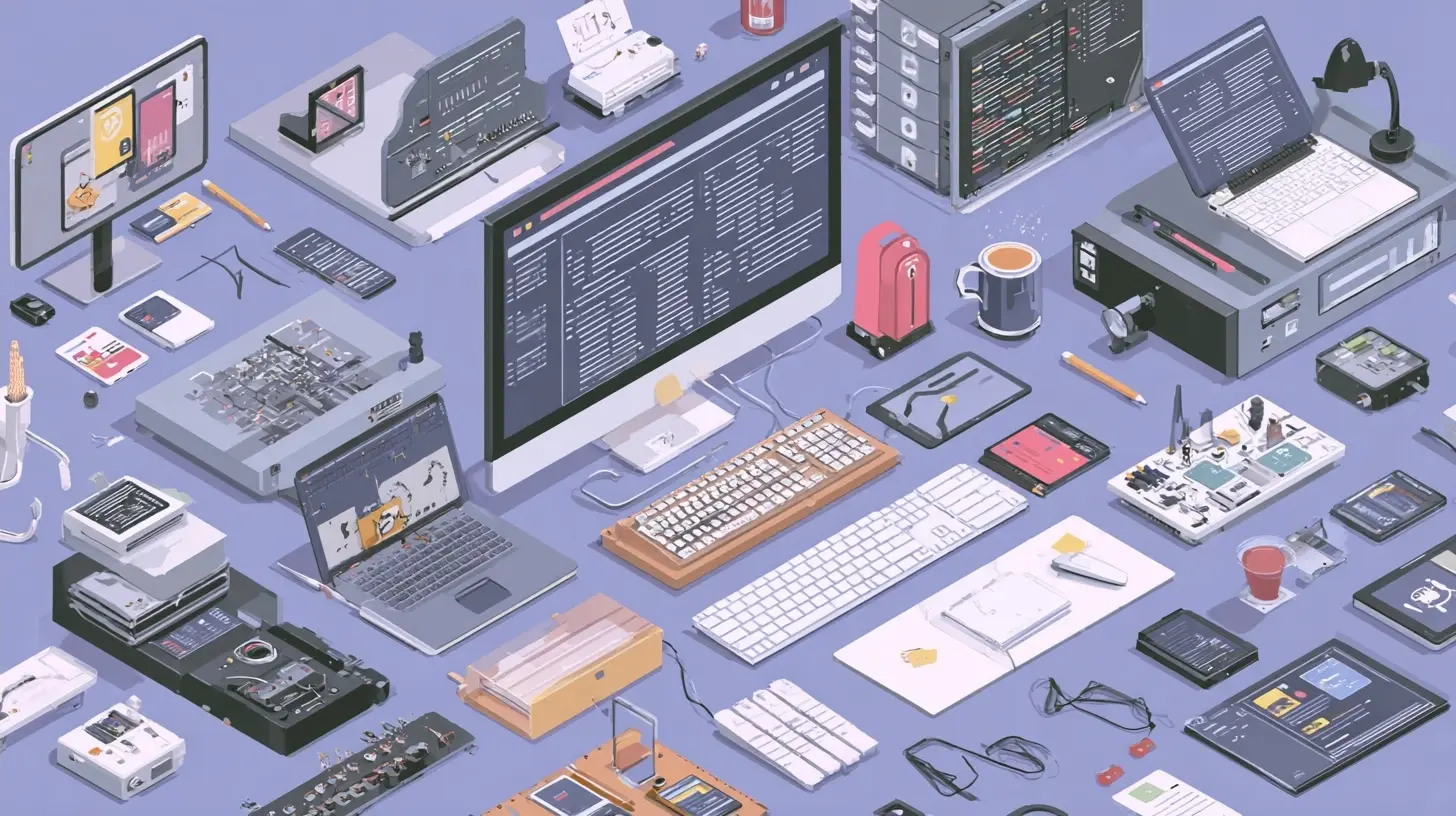
The File Sharing and Collaboration Mess
File sharing should be simple. It is not. Google Drive is the default for most startups because it has Google Docs, Sheets, and Slides built in. The real-time collaboration is actually good. But Drive search is an abomination. You will spend minutes looking for that file that you know you saved, only to find that it is buried inside a folder called "Final_Final_v2" that someone created in 2025.Dropbox is still around, and it is fine for raw file storage. But it is not great for collaborative editing. If you work with large files like design assets or video, you will need a specialized tool like Frame.io or Figma. Figma has become the de facto standard for design collaboration. It is so good that even non-designers use it for whiteboarding and diagramming.
The biggest mistake I see startups make is treating the file storage tool as a knowledge base. They put documents in Drive and then wonder why nobody can find the procedures manual. The solution is to have a strict rule: everything that is a "living document" lives in your wiki. Everything that is a finished artifact lives in a file storage system. Do not mix them.
The Syncing Nightmare
Real-time sync is great until it is not. If you have two people editing the same spreadsheet at the same time, you will get conflicts. In 2027, some tools handle this better than others. Google Sheets is decent. Excel, when used through Teams, is also decent. But the real problem is when you have to move data between different tools. You will end up with a pipeline that exports from one SaaS product, transforms it in a script, and imports it into another. That pipeline will break at 11 PM on a Friday. You will be the one fixing it.The Knowledge Base and Internal Wiki
Every remote team needs a place to store its collective wisdom. Notion, Confluence, and a few newer tools like Slite and Tettra are the main options. Confluence is powerful but feels like it was designed by a committee of bureaucrats in 2005. Notion is flexible and popular, but it has a tendency to become a chaotic mess of nested pages and orphaned databases.The key to a successful wiki is not the tool. It is the structure. You need a clear hierarchy. You need an owner for each section. You need a review process that ensures content stays current. Most startups ignore this and end up with a wiki that is full of outdated onboarding documents and half-written engineering specs.
In 2027, I recommend a simple approach. Use Notion with a strict template. Every page must have a status: Draft, In Review, Approved, or Deprecated. Every page must have a last-reviewed date. If a page has not been reviewed in six months, it gets flagged. This is tedious, but it is the only way to prevent the wiki from becoming a digital landfill.
The Automation Glue
The real magic of the all-remote stack is not any single tool. It is the automation that connects them. Zapier and Make (formerly Integromat) are the standard choices. They let you create workflows like "When someone submits a form in Typeform, create a task in Asana and send a Slack message to the sales channel."This is powerful. It is also a trap. You will spend hours building automations that save you minutes. You will create a monstrous Zap that has forty steps and fails silently. You will not discover the failure until a customer complains that their onboarding email never arrived.
The best practice is to automate only the things that are repetitive and high-volume. Do not automate the exceptions. Keep your automations simple. If a workflow has more than five steps, you should probably write a script or use a proper integration platform like Workato.
The AI Layer
In 2027, every tool has an AI assistant. The AI can summarize meetings, draft emails, write code, and generate images. It is impressive. It is also a massive productivity sink. You will spend more time editing the AI's output than you would have spent just doing the task yourself.The key is to use AI for first drafts and brainstorming, not for final output. Let the AI write a rough outline for your blog post. Then you rewrite it. Let the AI generate boilerplate code. Then you review it. Do not trust the AI to be correct. It is confident, but it is often wrong.
The Security and Compliance Backstop
Remote startups collect data. That data needs protection. In 2027, you cannot just use a password manager and hope for the best. You need single sign-on (SSO) through something like Okta or Google Workspace. You need device management through something like Kandji or JumpCloud. You need to enforce multi-factor authentication on every account.The mistake startups make is thinking that security is only for enterprise companies. Then they get hacked. Then they spend a fortune on incident response. The tools are not that expensive. The cost of a breach is much higher.
The Reality Check
Here is the honest truth about the all-remote tool stack in 2027. The tools are not the problem. The problem is that remote work requires more discipline, not less. You need to write things down. You need to over-communicate context. You need to trust your team to work without supervision.I have seen startups with a stack of ten tools that work beautifully because the team has strong norms. I have seen startups with the same stack that fall apart because nobody updates the status, nobody reads the wiki, and everyone is in a different meeting all day.
The best tool stack is the one your team will actually use. Start small. Add tools only when you have a specific pain point. Do not adopt a tool because it is trendy. Adopt it because it solves a problem.
And remember: if you find yourself spending more time managing your tools than doing your actual work, you have the wrong stack. You do not need another integration. You need to simplify.
So go ahead. Sign up for the twenty SaaS products. Set up the automations. Configure the AI. And then spend the next month wondering why your team still communicates through email.
Welcome to the future of work. It is exactly like the past, only with more subscriptions.
all images in this post were generated using AI tools
Category:
Remote Work ToolsAuthor:

Jerry Graham
Discussion
rate this article
1 comments
Thornefield Fletcher
In 2027, the remote tool stack will be so advanced, even your coffee maker might have a Zoom account!
September 9, 2026 at 2:54 AM
Jerry Graham
Haha, who knows? Maybe we'll have virtual coffee chats with our machines by then!