Samsung Electronics and LG Uplus Collaborate on ISAC Technology for 6G
May 29, 2026 - 10:03
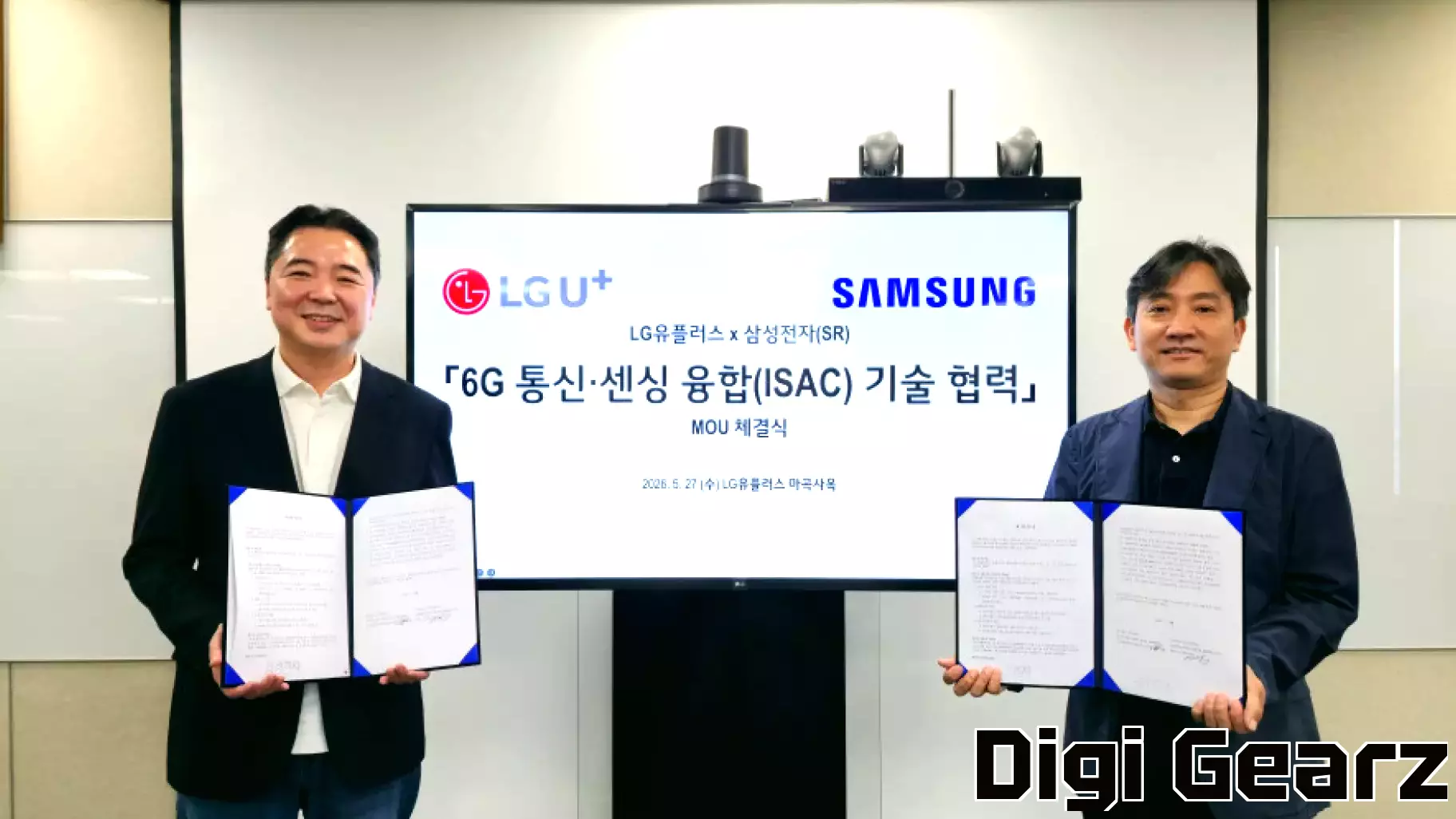
Samsung Electronics and LG Uplus have announced a partnership to advance Integrated Sensing and Communication, or ISAC, technology for next-generation 6G networks. The collaboration aims to combine wireless communication with radar-like sensing capabilities, allowing base stations to detect objects, measure distances, and analyze environments in real time.
Under the agreement, the two companies will jointly research and test ISAC systems. The technology is expected to enable 6G networks to not only transfer data at ultra-high speeds but also perceive physical surroundings. This could support applications such as autonomous driving, drone navigation, and smart factory automation.
Samsung's Vice President JinGuk Jeong and LG Uplus CTO Sangyeob Lee signed the memorandum of understanding. They emphasized that ISAC is a core component of future 6G standards. Unlike current 5G networks, 6G is designed to integrate sensing directly into the communication infrastructure, reducing latency and improving accuracy for location-based services.
The partnership will focus on developing signal processing algorithms and testing prototypes. Both companies plan to contribute their findings to global standardization bodies. Industry analysts note that South Korea is positioning itself as a leader in 6G research, with major telecom and tech firms racing to secure patents and early-use cases.
No specific timeline for commercial deployment was announced, but the collaboration is expected to accelerate the transition from theoretical research to practical field trials.
MORE NEWS
October 8, 2026 - 12:07
Collin College Electronic Engineering Technology Program and Dean of Academic Affairs and Workforce Programs Receive 2026 Tech Titans AwardThe Electronic Engineering Technology program at Collin College has received recognition from Tech Titans, a regional technology association. The organization presented the Tech Titans of the...

October 7, 2026 - 18:31
How a Brainless Alga Led to a Nobel-Winning Method for Controlling Neurons With LightThe ability to switch specific neurons on and off with a flash of light did not begin in a neuroscience lab. It began in a pond. Researchers studying a single-celled alga noticed it swam toward...

October 7, 2026 - 08:56
Micron Technology Is Not At Its Peak, At Least Not YetMicron Technology has secured long term commitments for a substantial share of its future production. More than 75 percent of the company`s calendar year 2027 output is already locked in through 26...
October 6, 2026 - 18:02
Hofstra University law school opens new legal technology hub through lawyer’s $1 million endowmentHofstra University`s law school has established a new center focused on legal technology, funded by a one million dollar endowment from an attorney. The institute will expand the school`s existing...